Judith MacKenzie always says that if you're concerned about time, perhaps working with textiles isn't right for you. I understand this logic and most of the time am willing to accept that it takes time to knit a sweater, or spin a skein of yarn, or wash a fleece, or prepare fiber for spinning. It takes time to weave a cloth - heck, it takes time just to warp a loom! - and it takes time to crochet a shawl or sew a dress. I get that instant gratification does not exist in the textile world and if we want good results, we have to be willing to invest a significant amount of time to our craft. But I'm here to tell you that last night at 10:10pm (I know this because it's when I looked up at my clock in desperation), I thought that thing that people in our world should never think. I thought, "When is this going to be over?!" Now, this isn't the first time that a project has lasted longer than I might wish it to, but with spinning I run into the problem that I can't just start a new project to take the edge off. With knitting, if I'm really not feeling the project I'm working on, I may cast on something quick like a hat or fingerless mitts before returning to the original project. Spinning is different because I only have one wheel and although it's possible to just put on a new bobbin and spin something else for a while, I prefer not to do that because I'm afraid that upon returning to the current project, I wouldn't be able to get the wheel settings just right to continue spinning the same yarn. And it's not just the wheel settings that I'm concerned about, it's my settings as well. A few weeks ago a friend on Ravelry asked me for my opinion on knitting multiple projects at the same time and, to my surprise, I was quite opinionated about the subject. I won't get into that right now (much), but one of my concerns when switching from project to project in knitting is that my tension will change. If I switch from knitting a lace shawl to a worsted-weight sweater to socks, I make tiny changes in the way that I hold and tension my yarn and it works different muscles. If, for example, I knit on a lace shawl for several days and then decide I want to knit a bulky hat, that's going to feel really weird to my hands until I get adjusted. I have several pairs of not-quite-the-same-size mittens to prove this fact. The same goes for spinning. It's not just the wheel that needs to be adjusted when I start a different project. I need to adjust myself as well - how I hold the fiber, how I draft the fiber, how quickly I treadle, etc. Normally I don't feel so strongly about this, but my current spinning project did take a bit of trial and error to figure out exactly what needed to be done (to myself and to the wheel) to produce the yarn that I'm looking for.
The yarn that I'm looking for is laceweight and I'm here to tell you that it takes forever to spin, or at least that's how it feels. The fiber itself is a treat to work with, but I think I've reached the point with this project at which I need a break. I'm almost halfway done, but it took a long time to get here.
That little bit in my hand is what's left of the first 2oz. and I predict that it will take at least 6 hours to get that spun up. Maybe I just need to look at my time to production ratio a bit differently. It's easy for me to look from my fiber to the clock and conclude that although I've spun for an hour and a half, no noticeable difference has been made (which is exactly what happened last night). But if I look at the yardage that I spun in that time, it's obvious that something did indeed happen, it's just not as easily measured visually as watching my fiber not change for hours on end. It's not my wheel's fault and it's not my fault and there's not really anything I can do about it. It's simply that spinning laceweight just takes time.
The resulting 2-ply is actually quite nice. After a wash it's surprisingly springy and because it's an 80/20 BFL/silk blend, it shimmers in the sun. I do really love the yarn and don't hate the process, it's just that I'm anxious to move on to the next spinning project. At this point I keep going back and forth about what do to. I could stop after I finish these 2oz. knowing that I have enough singles spun to produce hundreds and hundreds of yards of lace yarn or I could charge ahead and spin the other two ounces and get enough yarn to knit, well, anything that my heart desires. Stopping now would be somewhat limiting, but it would also mean that I could start something else on my wheel, which is always exciting. What would you do? I suppose I could also set this bobbin aside with some samples to remind myself of exactly what I'm aiming for and hope I can reproduce it. Why is it that the least important decision I could possibly make is the one causing me so much stress?
Monday, August 19, 2013
Wednesday, August 14, 2013
Washing Alpaca Fleece
Last week I decided that it would be a good idea to try to wash the fleeces sitting in my closet while I still had the benefit of warm summer days, which allowed me to sort my fleeces outside and aided in drying them with the windows open to keep the air circulating. This way if I decide this winter that I would like to do something with one of them, I'll have a nice clean fleece to work with. I thought I'd document here what I did to wash them both as a reference for myself and for anyone else who is interested. This all comes with the disclaimer that I had never washed a fleece before, but did consult a number of references, including a few alpaca farmers and the owner of a fiber mill who specializes in processing alpaca fiber, so rest assured that although this is not the only way to wash an alpaca fleece, it is perfectly acceptable. There are two more things to keep in mind with this process:
1. This process is similar, though not identical to how one might wash a sheep fleece. Alpacas do not have lanolin and other oils/waxes on their fleece that require scouring with hot water to remove them. When washing an alpaca fleece, the goal is to remove the dirt/dust/sand that they so lovingly roll around in all year. Because of the absence of oils and waxes, you do not need a scouring agent or extremely hot water. Any mild detergent will work, including wool wash, dish soap, or even shampoo. The temperature of the water that I used throughout the process is what I might use to run a bath or take a shower although you could achieve the same results with tepid or lukewarm water as well.
2. This process does not do a good job of maintaining the lock structure of the fiber. For this fleece I wasn't concerned about this as I will most likely be carding the fiber for spinning. If you want to work with individual locks or plan to comb your fiber, there are other ways to wash the fleece that will give you more control over the locks. If, however, you wish to wash a large quantity of fiber for carding or felting, this process works perfectly well.
I first spread out my fleece as best I could so that I could sort the fleece into different piles.
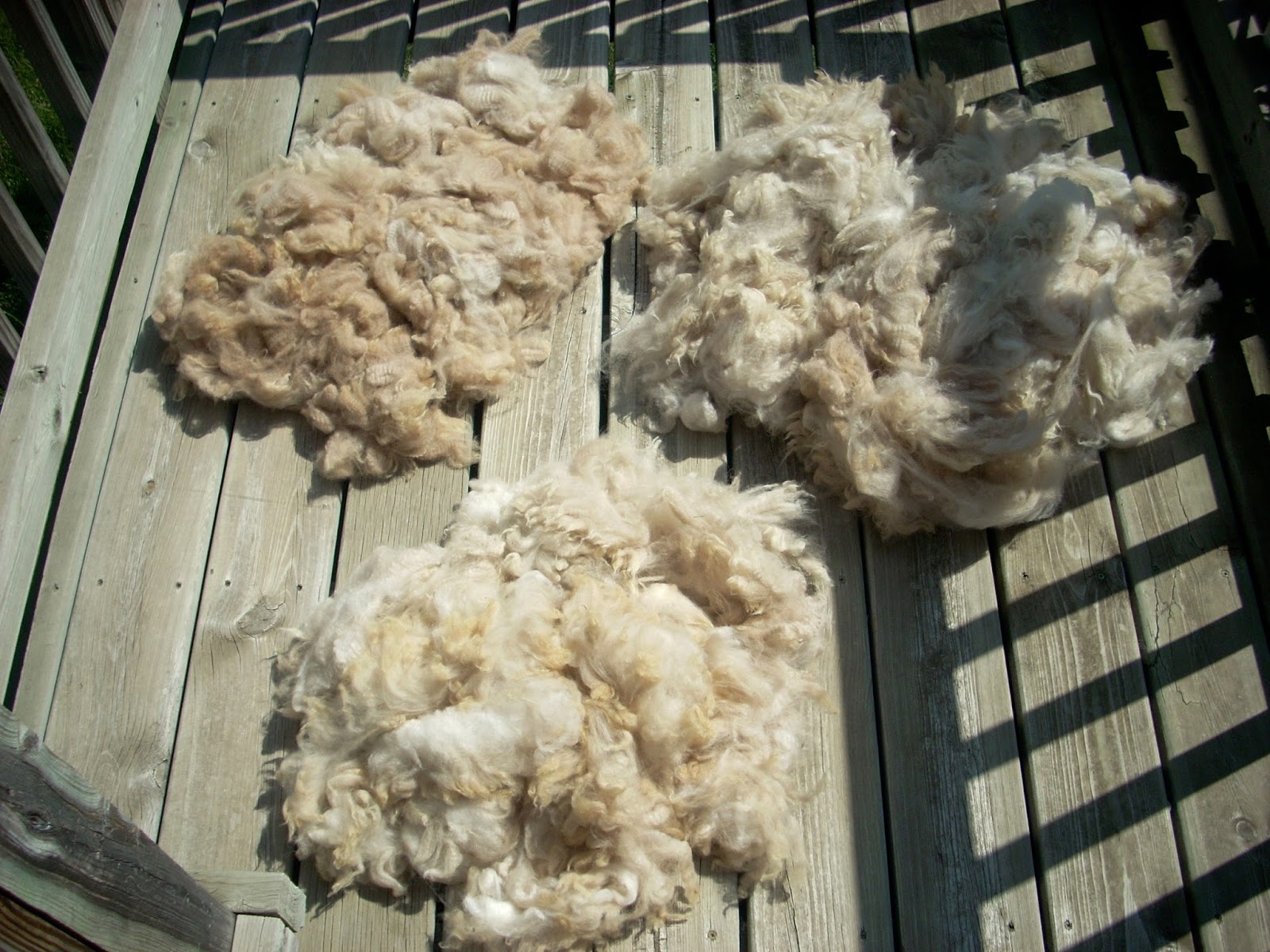
With a sheep fleece this is easier to do because the fibers tend to hold together a little better, but all you want is to be able to see the whole fleece at once. Often when you buy a fleece it will already have been skirted (the coarser leg and belly hairs, felted bits, and really cruddy bits removed), but what you want to do is feel around with your hands for any patches that aren't as soft or seem to have a slightly different texture, patches where the fibers are shorter or longer, and you can also remove any large bits of VM (vegetable matter) and 2nd cuts if there are any (these occur if the shearer goes over the same spot more than once or cuts up into the lock, resulting in really short bits that will cause problems when it's time for carding or spinning.) I got this particular fleece from Teresa at Hollyhock Farm Alpacas and it was already wonderfully skirted and free of 2nd cuts. I sorted the fleece into three different piles from coarsest to softest (but let's be honest here. This is a baby alpaca fleece and there was no such thing as a "coarse" hair. It's all relative.) If there was a patch that was particularly dirty or muddy, I would have also set that aside for extra cleaning.
I then proceeded to wash the fleece in four separate batches, the larger pile in the top right (above) split into two batches for washing. Take a lingerie bag and fill it relatively full with fiber. You want to make sure there's room for the water to flow through the fiber, but keep in mind that once the fiber gets wet it will compact a little bit, so you can fit quite a bit in there.
I used a larger laundry bag and simply tied the top shut. If possible, you want to use a bag that has larger holes like the one above rather than a superfine mesh because it will allow more of the dirt, sand, and VM to wash out during the process.
Fill your sink/laundry tub/bucket/whatever you're using to wash the fleece with enough water that the fiber can be fully submerged and add your detergent. I filled my sink with 4 or 5 inches of water and used about a tablespoon of detergent.
Now you can gently, GENTLY, press the fiber into the water. You can let it sink down on its own, but the fiber is so airy that it just floats on top for a while. You want to agitate the fiber as little as possible. Just press down making sure that the water has completely wetted your fiber. Remember, with warm water, soap, and agitation you fiber will begin to felt, so do what you can to minimize how much you agitate the fiber. You can't do anything about the water or soap.
You'll notice that the water will almost immediately begin to turn brown. Good, it's working.
Let the fiber sit for 15-20 minutes, then press it down again to get as much dirt out as you can. The water will be gross.
Remove the lingerie bag and gently, GENTLY, squeeze out any excess water and set the bag aside while you drain the sink and refill it with clean water. Repeat the process a second time, adding detergent (you don't need as much as in the first wash) and again letting the fiber sit for maybe 10-15 minutes. Remove the fiber and refill the sink with clean water again. Keep in mind that you never want to run water directly on to your fiber. This is agitation and will felt your fiber. Always remove your fiber before refilling the sink with water. Got it? You should also do your best to always match the water's temperature from one rinse to the next. Moving fiber from hot water to cold water will shock the fiber and cause felting. It's a great trick if you intend to do it, but it's better to be careful.
At this point your fiber should be clean and it's time to rinse out the soap and any residual dirt/dust that is still in the fiber. With your sink full of clean, non-soapy water, submerge your fiber again. It's not necessary to soak the fiber, but press it down a few times to make sure the water is running through all the fibers. You might want to gently, GENTLY, lift the lingerie bag out of the water once or twice to make sure the soap and dirt is washing out. At this point, your water will still turn a very light brown. Remove the fiber, drain the sink, refill it with clean water once more, and rinse the fiber a second time. Your water should stay clean.
So that's two washes and two rinses. If you're washing more than one batch, you don't need to drain the last rinse water. Just add detergent and use it as your first wash for the next batch of fiber. While the new batch of dirty fiber is soaking, you can take your clean fiber (still in the bag) and roll it in a towel and squeeze it or stomp on it to get as much water out as possible. Do not wring it out, just squeeze. Only squeezing. Alternatively, you can place it in your washing machine and spin the water out on the spin cycle, which is what I did. But be sure that your washing machine's spin cycle really only spins and doesn't add rinse water. We don't want water running directly onto our fiber. Agitation and all that.
When you take your fiber out of the bag, it will stay in a big clump like this:
It shouldn't be felted together, so gently, GENTLY, pull it apart and lay it out to dry. I MacGyver-ed a drying rack using some plastic netting, clamps, and the bed in my spare bedroom, but you can use a clothes drying rack, a sweater rack, or anything else that allows good air circulation.
Be sure to place an old sheet under the spot where you're drying your fiber. There will still be bits of VM, sand, and other particles that don't disintegrate and therefore didn't wash out of the fleece and they will fall out as you pull the fiber apart. As my fleece was drying I would also give it a gentle shake/bounce every once in a while to loosen that up.
In no time you'll have your whole fleece drying while you ponder the infinite ways in which you can use it. Just be sure that the fleece is completely dry before you store it. The last thing we want is a moldy or mildewed fleece.
The end.
Wednesday, August 7, 2013
Safety Nets
I can't imagine it would surprise you if I were to say that a vacation that involves spending a week and a half on a lake with no obligations is relaxing. I think my nephew (2 years old) summed it up nicely as we were packing up when he said, on the verge of tears, "I want to stay at the cabin forever!" Me too, kiddo, me too.
Despite the fact that I took over 300 pictures while at my cabin, I only took 12 with my camera (the rest were with my phone) and 260 were of either my brother or my dog. In years past I would get up early to watch the sun rise over the lake. I would never set an alarm, but some internal clock would wake me minutes before the sunrise each morning. This year I think I left my internal clock at home. I only got up to watch the sunrise once, and even then I was tired, cranky, and cold and crawled back into bed right before the sun actually rose above the trees. Here's the only photo I took, before deciding to curl back up on the couch.
Most of the days were quite windy and the lake was always in motion. We only had one or two days of rain and the rest were warm enough for me to lay around in my bathing suit, provided the sun didn't hide behind a cloud. As soon as the sun started to set, however, it was jeans and a sweatshirt for me. Check out this sunset, though.
You can't make that up.
As far as knitting is concerned, I didn't do nearly as much as I thought I might, which in all honesty is fine by me. Like I said in my last post, knitting acted more like a safety net than a life preserver, if that makes any sense. I know it's there if I need it, but there's no need to wear it at all times. I knit one sock and did a bit of work on my Ashby, but for the most part, I chose to spend my time laying around in the sun, kayaking, playing card games, swimming, canoeing, drinking coffee, or sitting by the bonfire. (I also went waterskiing once and while I used to do it all the time when I was younger, it has been probably five years since I did it last and boy, is that a workout for your legs! I was embarrassingly sore the next day. I also had a really hilarious wipeout that resulted in the ski smashing against my shin so hard I'm convinced there's a fracture in there somewhere while at the same time nearly tearing my swimsuit off my body. And I don't mean that my suit got pulled down a bit when I fell. I mean that the entire side seam tore open and for the rest of my skiing experience, I tried to pretend that I wasn't skiing with a loincloth rather than a bathing suit. I'm sure the entire lake got quite a show.)
But I digress, I was talking about my knitting. At the last minute I decided to only bring enough sock yarn for one pair rather than two, and despite the fact that I was a little bit stressed that I was going to run out of knitting the whole time, it turns out I only knit one sock and didn't need enough yarn for four.
It continues to be near impossible to take a decent sock photo when the sock is on your own foot, but I did my best (and believe me, this one is the best of the lot.) The yarn is Malabrigo Sock in some kind of blue and I opted to go with a basic K2, P1 ribbing with 1x1 twisted rib for the cuff. Super simple and it turns out that's exactly the kind of knitting I wanted. It was so relaxing that I sped past the point where I should have started the gusset increases by two inches and had to rip back, but no harm done.
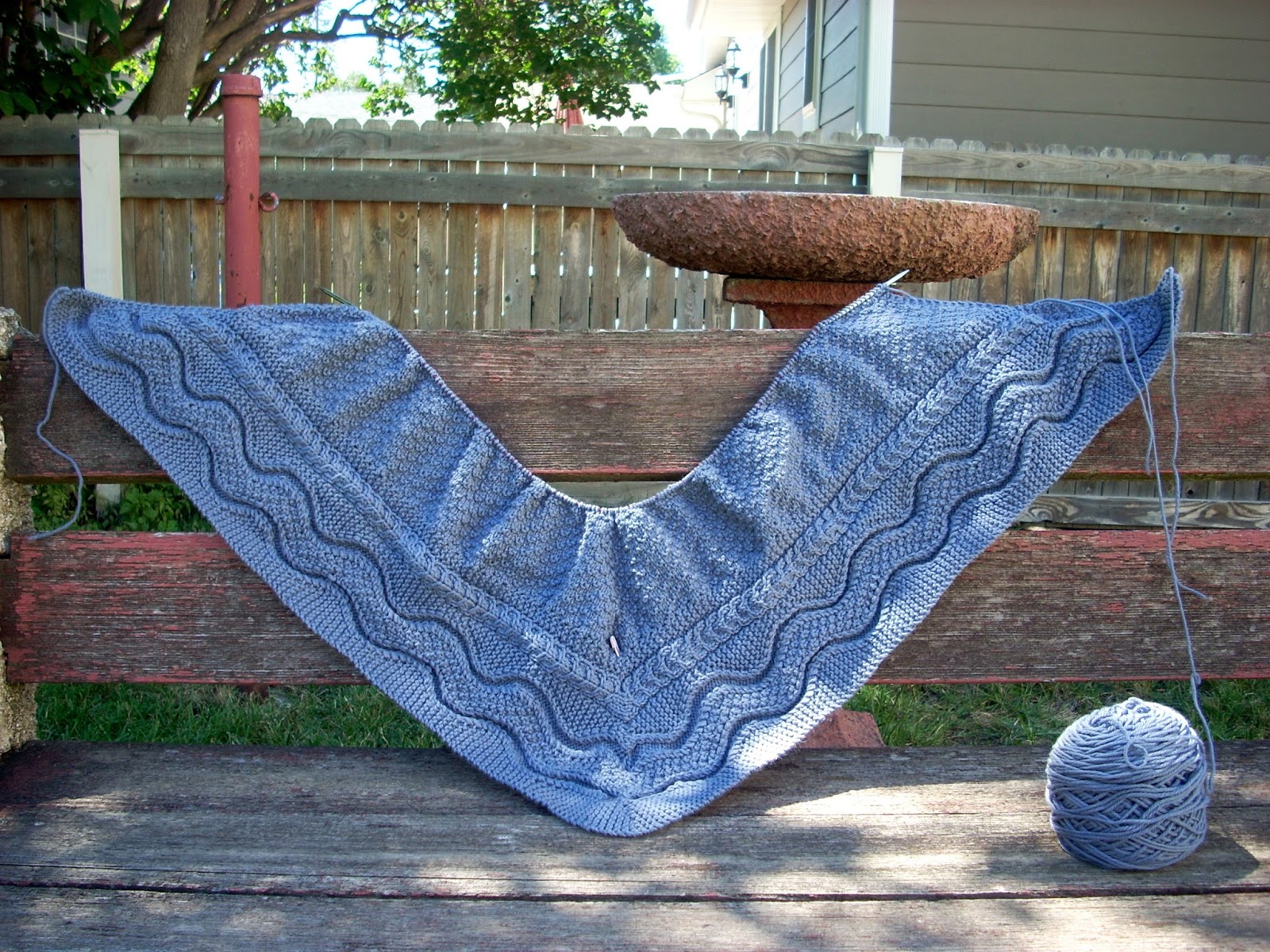
I did some work on Ashby as well. I finished the cabled edging and picked up stitches to knit the body of the shawl.
I'm convinced I could finish that one up with just a few more days of knitting, but (and this is so unlike me), I'm more interested in finishing the second sock first. Since when do I feel compelled to finish the second of anything? I always seem to have that "been there, done that" attitude when it comes to making the second sock, mitten, fingerless glove, whatever. I think the reason I want to finish this pair is because I got my first taste of the cold weather to come while in North Dakota (one night the temps hit 40) and I kept thinking how nice it would be to have a pair of wool socks. And nice it will be, I'm sure of it.
Are you feeling the change in weather? Have you adjusted what you're knitting accordingly?
Tuesday, July 23, 2013
Making Plans
In a few days I'll be heading up to my family's cabin in North Dakota. I've written about my cabin several times before on the blog (here, here, here, and here) and my incredible love for the sunrises and calm of being up there. For the next week and a half I will be blissfully removed from technology - no tv, no computers, no cell phone service, and while I embrace this removal from the outside world, it means I have to be thorough in my plans for what knitting to bring with me. I have to have my patterns picked out and printed, yarn wound, notions collected, and needles ready to go. This trip is unusual in that while I'm there, I don't find knitting to be a necessity. I could (probably) spend the whole week and a half without knitting and be just fine because there's so much more to enjoy while I'm there. To begin with, I could watch the birds all day long. I could spend hours and hours swimming in the lake, laying in the sun, playing cards, doing crossword puzzles, reading a good book, or indulging in a day of general laziness. But there's always a significant chance that there will be several days of thunderstorms that leave me trapped in the small cabin with 12-15 other people and then, THEN knitting is not a question of how to spend my time, but a question of how to save my sanity. So you see, despite the fact that I may not need it, knitting is in no way optional when it comes to packing for this trip. (Not to mention it's a 10-hour drive each way.)
It's a little embarrassing to admit that I've been thinking about what to bring for a so long. In fact, the other day I texted my sister:
Me: "I don't know what knitting to bring to the cabin!"
Sister: "On no! how much time do you have to decide?"
Me: "Six days..."
You see, even a week before the trip I begin to panic that I might not be adequately armed with projects. But now I think I have it narrowed down. A few days ago I started Ashby so that I'd have it in the works for the trip. For a project like this I like to have it at least started so that if there are any troubles with the pattern or yarn, I'll know about it before I'm in the middle of the North Dakota wilderness.
I already know the pattern needs to be tweaked, but that's what prototypes are for, right?
And although I know that both of these projects will provide more than enough knitting for the trip, I'll also be bringing enough yarn for two pairs of socks as an insurance policy. I don't really knit socks, but I kind of like wearing them and I figured a long car ride or a rainy day at the cabin might force me to make some. Socks will also be much more mindless than designing a lace shawl or knitting cables, so it will be nice to have them around. And before you ask, yes, the yarn for the socks is blue. Yes, both pairs. I know what I like.
What do you guys bring with you when you're planning for a trip?
It's a little embarrassing to admit that I've been thinking about what to bring for a so long. In fact, the other day I texted my sister:
Me: "I don't know what knitting to bring to the cabin!"
Sister: "On no! how much time do you have to decide?"
Me: "Six days..."
You see, even a week before the trip I begin to panic that I might not be adequately armed with projects. But now I think I have it narrowed down. A few days ago I started Ashby so that I'd have it in the works for the trip. For a project like this I like to have it at least started so that if there are any troubles with the pattern or yarn, I'll know about it before I'm in the middle of the North Dakota wilderness.
That's the first half of the border, but I predict that by the time I climb into the car, I'll have the border finished and will have preferably picked up the stitches to begin the body of the shawl. (I'm knitting this shawl in Cascade 220.)
Then I have a lace shawl prototype in the works and I figured there's no better time to finalize the charts than while sitting outside soaking up the sun and listening to the wind blow through the trees.
And although I know that both of these projects will provide more than enough knitting for the trip, I'll also be bringing enough yarn for two pairs of socks as an insurance policy. I don't really knit socks, but I kind of like wearing them and I figured a long car ride or a rainy day at the cabin might force me to make some. Socks will also be much more mindless than designing a lace shawl or knitting cables, so it will be nice to have them around. And before you ask, yes, the yarn for the socks is blue. Yes, both pairs. I know what I like.
What do you guys bring with you when you're planning for a trip?
Saturday, July 6, 2013
Continuing Right Along
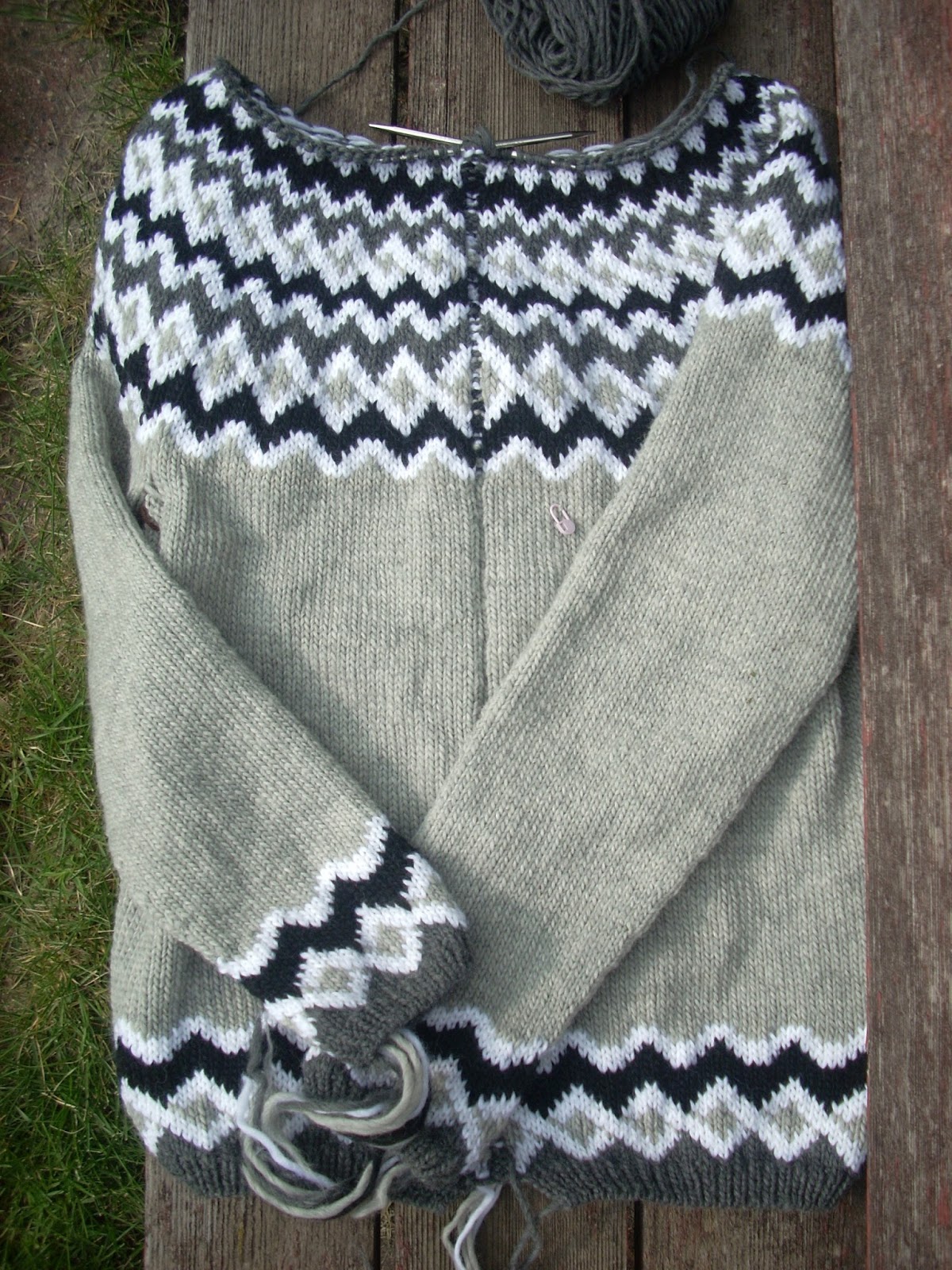
Despite the new yarn arriving for my next sample sweater, I managed to finish the yoke of my Icelandic sweater after all. I swatched for the new sweater and then while I was waiting for those swatches to dry, I quick knit up to the neck of my own sweater.
It seemed like a pretty reasonable stopping point now that the stranded work is done. What's left now is to knit the neckband, cut the thing open, add a zipper and weave in the ends. In short, the finishing. I also consider this a decent point to stop because I don't yet know what I want to do with the neckline. The directions in the pattern leave something to be desired and I think I'm going to have to play around a bit. Due to the patterning on the yoke, there was no simple way to add short rows in the back to raise the neckline, so I may try to do some of that in the collar. It's still to be determine, so I'll mull that over as I work on this next sample.
The sample, though I can't show you, is cruising right along. Despite it being for a 44" chest, I'm about 1/3 of the way through. Unemployment does have it's benefits, doesn't it? I've also been zipping through audiobooks like candy and it seems to keep the knitting moving along.
When I looked out into my backyard this morning, I saw this little guy snoozing on my sidewalk.
I think the bunnies feel safe in my backyard because it's fenced in and for years nobody has really gone back there other than to mow the lawn. This was my grandfather's house and at 93 with his memory failing, the time came for him to be moved into a nursing home where he'll have people looking after him more closely. Now I'm living in the house as we clean it out and getting it ready for sale. The bunnies have free reign of the backyard, but now that I've fixed up the garden space by the garage (I'm sure it hasn't been used in at least a decade. There was quite a bit of work to get it ready), I've had to make it clear that no bunny is allowed in that space. Apparently now they just sleep next to it. I can't blame them, though, it's quite peaceful back there. (And I have a habit of feeding them lettuce... how's that for mixed signals?)
It seemed like a pretty reasonable stopping point now that the stranded work is done. What's left now is to knit the neckband, cut the thing open, add a zipper and weave in the ends. In short, the finishing. I also consider this a decent point to stop because I don't yet know what I want to do with the neckline. The directions in the pattern leave something to be desired and I think I'm going to have to play around a bit. Due to the patterning on the yoke, there was no simple way to add short rows in the back to raise the neckline, so I may try to do some of that in the collar. It's still to be determine, so I'll mull that over as I work on this next sample.
The sample, though I can't show you, is cruising right along. Despite it being for a 44" chest, I'm about 1/3 of the way through. Unemployment does have it's benefits, doesn't it? I've also been zipping through audiobooks like candy and it seems to keep the knitting moving along.
When I looked out into my backyard this morning, I saw this little guy snoozing on my sidewalk.
I think the bunnies feel safe in my backyard because it's fenced in and for years nobody has really gone back there other than to mow the lawn. This was my grandfather's house and at 93 with his memory failing, the time came for him to be moved into a nursing home where he'll have people looking after him more closely. Now I'm living in the house as we clean it out and getting it ready for sale. The bunnies have free reign of the backyard, but now that I've fixed up the garden space by the garage (I'm sure it hasn't been used in at least a decade. There was quite a bit of work to get it ready), I've had to make it clear that no bunny is allowed in that space. Apparently now they just sleep next to it. I can't blame them, though, it's quite peaceful back there. (And I have a habit of feeding them lettuce... how's that for mixed signals?)
Wednesday, July 3, 2013
Mostly Alpacas
I thought you would all enjoy a few more pictures from the alpaca farm. Babies are arriving almost every day and it is a very exciting time at the farm.
The last time I was down at the farm (on Sunday), there were nine babies and I know that at least one more has arrived since then. Each one really has its own personality!
That little black one is the smallest of the group, but he's quite a handful. He's like the little dog who isn't aware of his size and challenges every German Shepherd that walks past.
We call him Oh, Henry! because he is such a handful (his mother is named Skittles and that lineage is all candy bars). That won't be his documented name, however, because his mother had previously been sold and the new owner will have to choose a name for this little guy.
You can tell these babies have a lot of energy and they are so much fun to watch! They have the same carefree nature as human children and I admit it's very entertaining to watch them stumble around as they get used to running, prancing, and playing.
What a surprise! The other babies are all pretty solidly colored - one white one has beige ears and a brown one has white legs - but none of the others have big splotches like this one! I told the farmer that if he's not suitable for the show ring, I'd be happy to take him off her hands. He comes from one of my favorite families, too - his mother's name is Symphonie. (That family also has Melody, Harmony, Aria, Rhapsody, and probably some that I'm forgetting.) I'm sure I have room in my back yard for him.
And here's Harvi, the friendliest guard llama you'll ever meet.
She loves to know what's going on at all times and it seems her favorite thing to do is to interrupt conversations by standing in between the two people talking. All the alpacas know that she can protect them, though, so they have a habit of hiding behind her when they're unsure about anything in the field.
But like I said, she's just a sweetheart.
The last time I was down at the farm (on Sunday), there were nine babies and I know that at least one more has arrived since then. Each one really has its own personality!
That little black one is the smallest of the group, but he's quite a handful. He's like the little dog who isn't aware of his size and challenges every German Shepherd that walks past.
We call him Oh, Henry! because he is such a handful (his mother is named Skittles and that lineage is all candy bars). That won't be his documented name, however, because his mother had previously been sold and the new owner will have to choose a name for this little guy.
You can tell these babies have a lot of energy and they are so much fun to watch! They have the same carefree nature as human children and I admit it's very entertaining to watch them stumble around as they get used to running, prancing, and playing.
That little brown girl is such a beauty and I'm sure she'll be a show girl next year. Just look at how curly her fleece is! And aren't those eyes the most adorable things you've ever seen? And just look at one of the most recent arrivals:
And here's Harvi, the friendliest guard llama you'll ever meet.
She loves to know what's going on at all times and it seems her favorite thing to do is to interrupt conversations by standing in between the two people talking. All the alpacas know that she can protect them, though, so they have a habit of hiding behind her when they're unsure about anything in the field.
But like I said, she's just a sweetheart.
I really could spend all day every day at that farm. I don't think I'll ever grow tired of it!
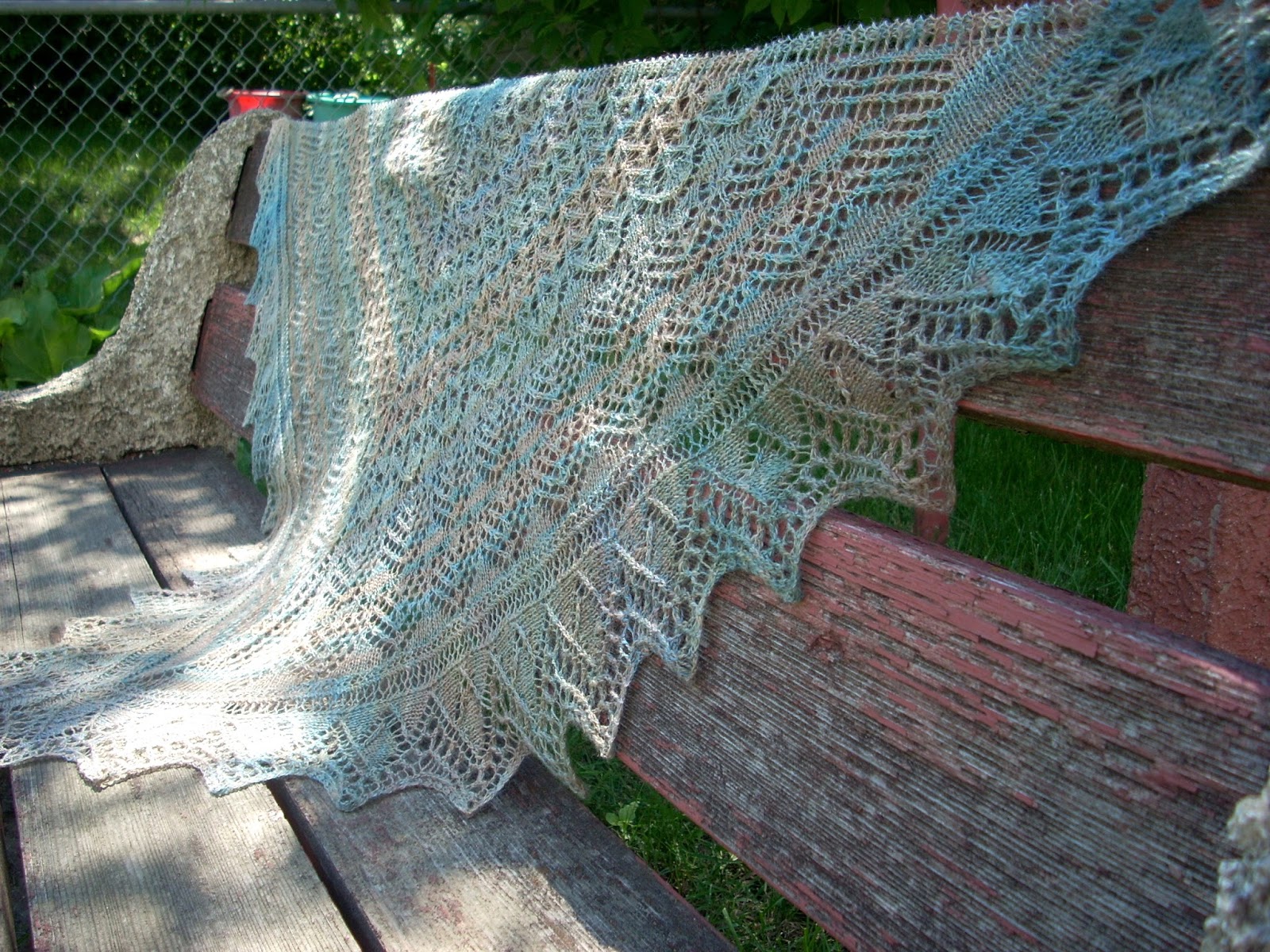
Shall we look at some knitting now? I thought you'd like to see what my Mountain Peaks Shawl looks like now that it's blocked.
It really blocked nicely and has the perfect combination of drape and springiness.
And I think using handspun gave it a great amount of character, too. Remind me to knit with my handspun more often! I think I get into the habit of considering a skein of handspun to be finished once it is washed and dried, but I really need to follow through with the next step - knitting!
I'll have to save this one to give as a gift sometime in the future. I'm sure I can find someone who'll love it.
And my Icelandic sweater is coming along nicely, too. I was trying to knit it up as quickly as possible because I have some more sample knitting to do, but I didn't quite make it to the finish line. The yarn for the next sample sweater arrived today and I still have much of the yoke to finish, so I'll have to set it aside for a bit, but I'm eager to see the finished product.
I tried it on today, though, and I really love the way it's fitting so far! This is definitely in the running to become my favorite sweater, but I tend to think that about each new sweater I knit. Only time will tell!
Happy 4th of July to everyone in the US! Don't do anything stupid with fireworks, mmmkay?
Tuesday, June 25, 2013
Lemonade, Figuratively Speaking
I always find it difficult to begin a blog post these days without apologizing or explaining why I have been away for so long. In truth I don't enjoy being away for so long for a number of reasons. The first is that I feel like I'm abandoning you guys. Today's post is prompted by a simple message I received on Ravelry. To paraphrase, it said "I read your blog", which was enough to make me feel guilty enough to update it.
The second reason I don't like blogging so infrequently is that I feel like there's no flow between posts. I often knit quickly enough that if too much time lapses between posts, I'll be showing you entirely different projects in each one. Something I personally like about other blogs is seeing the process of how something is created, which can't be achieved here unless I blog more often. Or knit more slowly. And I'd rather not knit more slowly.
Blogging at the rate that I do also causes me to omit a great deal of information, ideas, and thoughts that I would love to share with you guys. Believe it or not, there's usually something I want to share here on a near daily basis, but by the time I sit down to write a post, I have forgotten half of it, 40% seems obsolete, 5% is so belated that I don't bother sharing it, and the rest I try to cram into a single post, causing it all to be rather truncated and lacking my forgotten (rare) insights and even more rare witty remarks. Case in point? Alpaca shearing. Alpaca shearing at the farm was several weeks ago now and I never told you about it. At the time it was because I was tired after the 16 hours on the farm and I was quite emotionally distraught due to an incident near the end of shearing day and now it seems so long ago that I find myself thinking, "why bother?" So instead, here's a picture of me at the shearing. Imagine an entire post to go along with it, most of which would talk about how much fun I had. We sheared 89 alpacas and 1 llama that day and I got the best job in that I, along with Tamara (next to me in the photo) got to sort the fleece as it came off the animal. This means I got to roll around in touch the fleece of almost every single animal on the farm. I missed a few due to the fact that I was forced to eat lunch. It also means I got spit on and peed on all day long, but does it look like I cared? I learned so much that day.
Since my last post, I've also celebrated the marriage of one of my very best friends (I played the bagpipes at her wedding), quit my job, and moved into a new house. Because I like to lay blame on factors outside of my control, I'm going to say that part of the reason I haven't been blogging is because I, once again, do not have internet access at my new place. Why? Because I'm cheap and can't afford it.
So there you have it. If you're annoyed by my less-than-frequent blog posts (and I know some of you are as I have seen reviews of my blog expressing such an opinion around the internet), be assured that I am right there with you. As my brother and I say, "you can't do much about lemonade." And no, that phrase doesn't make any more sense to us than it does to you, but I'm using it nonetheless. It started when we were having lunch at a restaurant and there was a mix-up between raspberry lemonade and regular lemonade and blah blah blah Minnesota nice it wasn't worth making a fuss about... essentially it means, to us anyway, something like "it is what it is" or "just go with the flow." (Full disclosure: the proper response to "you can't do much about lemonade" is "that's just what they say.")
Wow, I got way off track. This is a knitting blog, isn't it? Look here, I finished a shawl.
It's obviously not blocked yet, but I have a modicum of hope that once it is, it will look somewhat beautiful. I see that I haven't talked about this shawl in two months, so as a refresher, the pattern is the Mountain Peaks Shawl by Miriam Felton and I'm using some of my handspun superwash BFL, the fiber for which was gifted to me by Anne over at Wooly Wonka Fibers. I find this shawl particularly interesting because when indoors, the color (to my eyes) tends to read as some sort of light brown/beige/khaki/I don't know what I'm talking about when it comes to color. Only when the shawl is outside in natural light can you see those different colors, particularly the blue. In fact, I didn't even notice how cool the edging looked until I took it outside to take a picture today. I'm excited to block it now.
Because I seem to have a knack for tossing projects by the wayside as soon as I reach the finishing stage (and I have a vest, a sweater, this shawl, a pair of mittens, and a pair of fingerless gloves to prove this theory), I have already moved on to my next project. This time it's a thick, warm sweater, because I can think of nothing more appropriate or comfortable to work on in this 90 degree heat than a sweater that will most likely be too warm for 362 days out of the year.
I have both sleeves finished, which I am considering rather exceptional considering I have only been working on this project for three days (and one of them was wedding day). The pattern is Hlekkur by Védís Jónsdóttir and is my first venture into Icelandic patterns. I've wanted an Icelandic sweater ever since I saw the first photo in this post by Franklin Habit (and yes, I did just scroll through the past two years of his blog entries to find it). At one point I was just going to reproduce the one in that picture, but decided on a different pattern instead. (As an aside, if you do want the sweater in that picture, it's not necessary to make up your own pattern for it. It's right here. Or at least the information about the pattern is. I don't know how you would actually get your hands on it.)
Back to Hlekkur. I liked the pattern both because of how well the white stood out from the background and because it inspired in me the idea that an Icelandic sweater doesn't need to be a pullover. It can have a zipper if I want it to, and I want it to. The only difference is that when I'm done knitting a pullover, I will cut it open. Super simple. The pattern isn't available on Ravelry, but you can find it over on Patternfish. (It's free to make an account.) Thanks go to Mel for finding a source for this pattern. He also informed me that Hlekkur means "link", as in a part of a chain. This makes sense considering the patterning around the yoke.
A note about yarn choice:
I think it's important to understand the qualities of a particular yarn or fiber when choosing the yarn for a project. I am by no means an expert when it comes to Icelandic sweaters, but I do know that they are most often made with Lopi yarn. From my understanding, this is a yarn spun from Icelandic sheep - makes sense. Icelandic sheep have a double coat, meaning that there is a longer, coarser outer layer and a shorter, softer undercoat. Lopi yarn contains both fibers spun together to create a singles yarn. The long, coarse fibers provide strength against abrasion while the shorter fibers provide warmth and a bit of softness. Take this knowledge of the fibers and combine it with the fact that Iceland is cold and the sheep come in a variety of natural colors and it isn't hard to imagine how the first colorwork yoke came into being in Iceland. Colorwork shows off the beautiful array of natural shades and provides an extra layer of warmth against the bitter chills of winter.
All that being said, I am not using Lopi to knit my sweater. I am using Cascade Soft Spun. It is similar to the yarn called for in the pattern in that they are both loosely spun singles and I can get gauge with the Cascade yarn. One big difference is that Peruvian Highland sheep (which provide the wool for the yarn I am using) is not a double-coated breed and therefore my yarn does not have coarse guard hairs that will stand up well to wear and tear. What does this mean? My sweater will not last as long as a traditional Lopapeysa. My sweater will also most likely start pilling the minute I put it on, though a somewhat denser gauge may have the effect of staving this off a bit. My sweater will also be softer, which is the tradeoff. The important thing is that my yarn choice was a conscious, informed decision based on my understanding of the qualities of both the yarn called for in the pattern and the yarn I chose to substitute. By knowing how each yarn behaves, I am able to predict the type of fabric that would result from knitting with them and decide which I prefer. In this case I chose softness over longevity, even if it means my sweater won't be a true Lopapeysa. You can't do much about lemonade.
Subscribe to:
Posts (Atom)